

Introduction: Stop Asking “Which Is Better?” and Start Asking “Which Fits?”
For B2B marketers, the debate around Facebook vs LinkedIn ads often gets stuck in the wrong place. One platform is labeled “cheap but low quality.” The other is dismissed as “too expensive to scale.” Neither framing leads to a smart budget decision.
The reality is simpler—and more useful. LinkedIn and Meta (Facebook/Instagram) solve different problems at different stages of the funnel. Results depend far more on your ICP, offer, deal size, and measurement maturity than on the platform itself.
This guide breaks down LinkedIn ads vs Facebook ads through a practical B2B lens: targeting precision, cost and ROI tradeoffs, lead quality, and where each platform fits across awareness, demand generation, and ABM. You’ll walk away knowing when to choose one, when to use both, and how to test without wasting budget.
TL;DR
- Choose LinkedIn Ads if you need precise job-title or account targeting, sell to senior decision-makers, or run ABM or demand gen.
- Choose Facebook/Meta Ads if you want scalable reach, cheaper top-of-funnel traffic, faster creative testing, or strong remarketing. Platforms like MetaMatch and Vector can supplement Meta’s native targeting (with some caveats).
- Use both for full-funnel efficiency: Meta for cheaper reach and faster creative learning, LinkedIn for precise reach and reduced waste.
- Don’t compare platforms on CPL alone. Compare cost per qualified lead, SQL, or pipeline when possible. However, be mindful of not relying on last-touch attribution, especially if you have a long sales cycle.
- Tracking maturity matters. Meta performs best when fed strong conversion signals; LinkedIn performs even with limited data but still needs solid tracking to understand true pipeline impact.
If you want a fast decision, jump to the checklist at the end.
Facebook (Meta) Ads vs LinkedIn Ads: A High-Level Overview
What Each Platform Is Really “For”
LinkedIn Ads operate in a professional context. Users are in “work mode,” consuming industry content and thinking about tools, vendors, and solutions. LinkedIn’s core strength is explicit professional targeting such as job title, seniority, company size, industry, and account lists.
Facebook and Instagram operate in “scroll mode.” Users aren’t thinking about work, but they are highly engaged. Meta’s strength lies in scale, creative formats, and algorithmic optimization, allowing advertisers to reach large audiences at lower cost and let the system identify likely converters over time.
Neither platform is inherently better. They are optimized for different mental states and buying moments.
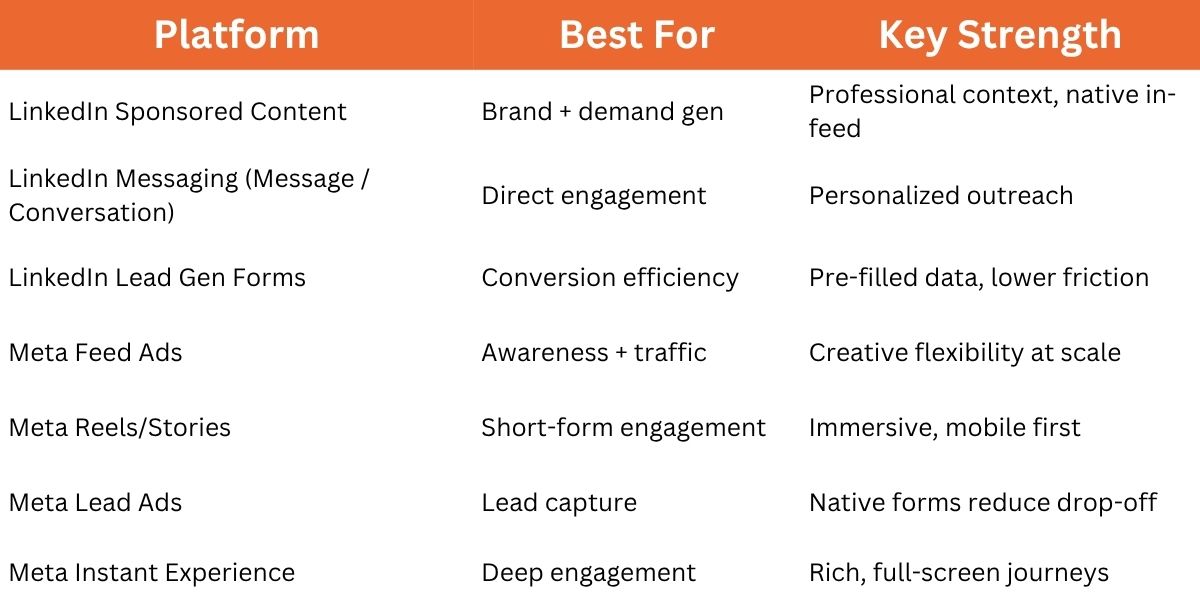
Key B2B-Relevant Ad Formats
LinkedIn Ad Formats
Sponsored Content
Native ads that appear directly in the LinkedIn feed (single image, carousel, or video). Best suited for awareness, thought leadership, content distribution, and demand generation. Because these ads resemble organic posts in a professional context, they perform well at the top and middle of the funnel.
Message Ads & Conversation Ads
Ads delivered directly to a user’s LinkedIn inbox. Message Ads feature a single CTA, while Conversation Ads offer multiple paths. These formats work best for mid- to bottom-funnel actions like event registrations or demo requests, but should be used selectively to avoid fatigue.
Lead Gen Forms
Native LinkedIn forms that auto-populate with profile data. These are ideal for capturing high-intent leads with minimal friction and often outperform landing pages due to ease of use and perceived trust.
LinkedIn Thought Leader Ads
Ads that allow companies to sponsor or “boost” organic posts from individual employees, such as executives or subject matter experts. These are ideal to humanize a brand, build trust, and achieve significantly higher engagement and click-through rates compared to traditional corporate ads.
LinkedIn Document Ads
Ads that enable sharing of full documents, such as whitepapers, case studies, or research reports, directly in the feed so users can read and download them without leaving the platform. Ideal for nurturing high-intent leads and providing deep educational value that establishes your company as a reliable knowledge leader.
Meta (Facebook & Instagram) Ad Formats
Feed Ads (Image, Carousel, Video)
Standard ads shown in Facebook and Instagram feeds. These formats are flexible and scalable, making them effective for awareness, traffic, creative testing, and remarketing.
Reels & Stories
Short-form, vertical, full-screen video placements designed for quick engagement. These formats drive strong reach and attention but require creative tailored specifically for mobile consumption.
Lead Ads
Native Meta forms that allow users to submit their information without leaving the platform. These are effective for driving lead volume at lower CPL, though lead quality often requires stronger qualification downstream.
Instant Experience
A fast-loading, full-screen mobile experience that opens from an ad. Best used for storytelling, product education, or richer pre-conversion journeys, though they require more creative effort than standard click-out ads.
Practical takeaway: Meta offers more creative surface area but demands greater production discipline. LinkedIn offers fewer formats, but better audience targeting.
Audience Targeting: Where the Real Difference Shows Up
LinkedIn Targeting Strengths
LinkedIn remains the gold standard for B2B audience targeting when precision matters. Advertisers can directly target:
- Job titles and functions
- Seniority levels
- Company size and industry
- Named accounts for ABM.
For example, if you sell compliance software to Directors of Finance at healthcare organizations with over 1,000 employees, LinkedIn allows you to define that audience explicitly, with no inference required.
This precision is why LinkedIn performs so well for ABM, niche industries, and senior buyers, even at higher CPMs.
Meta Targeting Strengths (and Why It Still Works for B2B)
Meta’s targeting is broader, relying on interests, demographics, and behaviors. Its real power, however, lies in the algorithm.
When Meta is fed strong signals such as form submissions, qualified leads, or offline conversions, it can learn who converts, even without job-title targeting. Over time, this can outperform manual audience construction. It’s even more powerful when a third-party B2B targeting solution is layered on such as MetaMatch or Vector. These tools allow B2B marketers to target their ideal buyers on platforms where professional data is typically limited, such as Facebook and Instagram, with the same precision they find on LinkedIn. However, keep in mind that targeting within platforms like MetaMatch and Vector match rates are variable and delivery remains probabilistic rather than deterministic. In other words, they improve targeting precision but cannot guarantee consistent reach or optimisation across specific accounts or senior decision-makers in the way LinkedIn can.
Meta also excels at:
- Lookalike audiences
- Cross-device retargeting
- Scaling once winners are identified.
A key caveat: third-party B2B targeting solutions are generally more effective in the US and may introduce privacy or compliance considerations in EMEA, making due diligence essential before rollout.
“Work Mode vs Scroll Mode” Messaging: Why Creative Must Adapt
One of the most common reasons B2B paid social underperforms isn’t targeting or budget. It's creative that doesn’t match the user’s mindset.
LinkedIn and Meta don’t just differ in audience data; they differ in how people are mentally showing up. That context should shape everything from headline structure to CTA strength.
LinkedIn Users are in “Work Mode”
LinkedIn users are already thinking about their role, industry trends, and tools that could help them do their job better. As a result, they respond well to direct, rational value propositions.
Effective LinkedIn creative typically includes:
- Clear articulation of who the offer is for
- Outcome-led messaging
- Explicit, professional CTAs
Clarity usually outperforms cleverness, especially for mid- to bottom-funnel offers.
Example:
“2025 B2B Demand Gen Benchmarks: How Top Teams Are Lowering CPL Without Sacrificing Lead Quality”
Meta Users are in “Scroll Mode”
On Meta platforms, users are consuming entertainment. Attention is fragmented, and ads compete with friends, creators, and short-form video.
As a result, Meta creative has to earn attention before it can sell anything.
What works well:
- Pattern interruption in the first 1–2 seconds (visual or copy)
- Simplified, benefit-led messaging (one idea per ad)
- Softer entry points (“See how teams are doing this,” “Watch the 60-second breakdown”)
Educational hooks, contrarian statements, or relatable pain points often outperform direct pitches in this environment.
Example:
“Most B2B teams are overpaying for ‘qualified’ leads. Here’s why.”
That same line would feel vague or clickbait-y on LinkedIn, but on Meta it can stop the scroll and invite curiosity.
Why Reusing the Same Creative Can Hurt Performance
Reusing creative is often necessary for scale, but running identical creative across LinkedIn and Meta without adapting for mindset typically leads to underperformance.
- LinkedIn-style ads on Meta can feel too transactional too fast.
- Meta-style ads on LinkedIn often lack clarity or professional relevance.
This mismatch often shows up in metrics like click-through-rate (CTR). The issue isn’t always platform. Sometimes, the creative is speaking the wrong language for the context.
Practical Takeaway for B2B Teams
Instead of only asking “Can we reuse this creative?”, also ask:
- What mindset is the user in when they see this ad?
- Is this message designed to educate, interrupt, or convert?
- Does the CTA match how ready this audience is to act?
Teams that respect this difference and adapt reused creative consistently see better engagement, stronger downstream conversion rates, and more reliable learning from both platforms.
Cost, Lead Quality, and Pipeline Math: What “Better Results” Actually Means
Typical Cost Structures
At a surface level, the cost differences between LinkedIn and Meta are well known:
- LinkedIn typically shows higher CPMs and CPCs
- Meta typically delivers lower CPMs and CPCs
But these numbers are often misunderstood.
LinkedIn costs more because you are buying certainty. You are paying for the ability to say, with confidence, this ad will be shown to people with specific job titles, seniority levels, and company attributes. That precision reduces wasted impressions but comes at a premium.
Meta costs less because you are buying probability. You are reaching broader audiences and relying on the platform’s delivery system to infer who is most likely to convert over time. Early results are cheaper, but relevance is learned rather than guaranteed upfront.
The mistake many B2B teams make is stopping the comparison here and concluding that Meta is “more efficient” because clicks or leads are cheaper. At this stage, the data is incomplete.
Why CPL Alone Is the Wrong Comparison
In B2B, the true cost of a channel isn’t what you pay for a lead. It’s what you pay for contribution to pipeline.
A $20 lead that never progresses is wasted spend. A $150 lead that consistently becomes an SQL may be far more cost-efficient in real terms. CPL can be a useful early indicator, but it’s a poor decision metric on its own.
To further understand why Facebook vs LinkedIn ads can’t be judged on CPL alone, look at what happens after the lead is captured.
Scenario: Same Budget, Different Outcomes
Assume a $10,000 monthly spend on each platform.
Lead-Level View (What Most Dashboards Show)
.jpg)
Initial conclusion: Meta looks 5× more efficient. Easy decision—right? Not yet.
Pipeline-Level View (What Actually Matters)
Now apply realistic B2B conversion rates downstream.
.jpg)
Now the platforms are much closer and LinkedIn is ahead on opportunity volume.
Cost per Opportunity (The Metric That Changes the Decision)
.jpg)
What changed? Nothing about the ads—only how far down the funnel we measured. For the sake of illustration, let's assume we are measuring first touch conversion of the primary contact associated with the deal. We will be posting another article on attribution soon!
Why This Happens
- Meta captures a larger, noisier audience early
- LinkedIn captures fewer leads, but with clearer professional intent
- The real difference shows up after the form fill
The Hidden Variable: Measurement Maturity
If measurement stops at form fills or thank-you pages, Meta will often appear “low quality” because it’s judged at the noisiest funnel stage. When measurement extends into SQLs and opportunities, Meta’s performance often improves over time as the algorithm learns which signals matter.
At this point, platforms are no longer just traffic sources. They are optimization systems, and the quality of data you feed them determines results.
Thankfully, advertisers can straightforwardly adopt advanced measurement techniques - through server-side tracking - which provide Meta algorithms with lower-funnel signals to optimize towards, producing more impact, sooner and more reliably.
Key Takeaways
- LinkedIn’s higher costs often buy predictability and intent
- Meta’s lower costs buy scale and learning potential
- CPL is a misleading metric unless paired with pipeline outcomes
- The more downstream data you can measure and share, the more accurate—and fair—your platform comparison becomes
Measurement and Tracking Essentials (and Why CAPI Is No Longer Optional)
Accurate measurement is what separates “we’re spending money” from “this channel is working.” For both LinkedIn and Meta, tracking maturity directly impacts performance, not just reporting. The platforms’ algorithms can only optimize toward what they can reliably see.
At a minimum, B2B teams should think about tracking in three layers:
- On-platform signals (clicks, impressions, CTR)
- Online conversions (form-fills, website conversions)
- Offline conversions (SQLs, opportunities, revenue)
The third layer is where server-side tracking and CAPI become critical.
Meta: Pixel + Conversions API (CAPI)
Meta’s optimization engine is heavily signal-driven. The more accurate and complete your signals, the better Meta gets at finding the right people and not just more people.
Historically, this relied on the Meta Pixel (browser-based tracking). That’s no longer enough.
Why the Pixel Alone Falls Short
- Browser tracking is increasingly blocked by ad blockers, privacy settings, and cookie restrictions
- Safari and Firefox limit third-party cookies by default
- You lose visibility into downstream actions that happen outside the browser (e.g. CRM updates)
This creates signal loss, which hurts both attribution and optimization.
What CAPI Solves
The Conversions API (CAPI) sends conversion events server-to-server, bypassing the browser entirely.
That means you can:
- Send cleaner, more reliable conversion data
- Pass “offline” events like SQL created, opportunity opened, or deal won
- Match users more accurately across devices
In practice, this allows Meta to:
- Learn which users actually convert downstream
- Build stronger lookalike and optimization models
- Improve performance even when front-end conversion volume is low
This is why Meta campaigns often struggle early and then improve dramatically once downstream CRM events are wired in via CAPI.
Key takeaway: Meta doesn’t just report on conversions. It learns from them. CAPI feeds the learning loop.
LinkedIn: Insight Tag + Offline Conversion Syncing
LinkedIn’s algorithm is less aggressive than Meta’s, but tracking still matters, especially for lead quality analysis and ROI measurement.
What the Insight Tag Covers Well
- Page views
- Lead Gen Form submissions
- Button clicks and basic conversion actions
Because LinkedIn’s targeting is explicit (job title, company, seniority), it can still perform reasonably well with lighter signal volume.
But that doesn’t mean you should stop there.
Why Offline Conversion Syncing Matters
Most B2B value happens after the form fill:
- Lead → MQL
- MQL → SQL
- SQL → Opportunity
If LinkedIn only sees “lead submitted,” you’re optimizing toward volume, not quality. Also, most form-fills are untracked, even if the person who converted was meaningfully influenced by Linkedin exposure.
By syncing offline conversions (from your CRM), you can:
- Attribute pipeline and revenue back to LinkedIn campaigns that contacts involved in those deals were exposed to or engaged with
- Compare cost per influenced SQL or opportunity not just CPL
- Identify which audiences and offers drive real business outcomes
Key takeaway: LinkedIn gives you precision upfront; offline conversion syncing tells you whether that precision is actually paying off.
What You Should Be Tracking (At Minimum)
To fairly evaluate LinkedIn ads vs Facebook ads, both platforms should track:
Primary Conversions
- Demo requests
- Lead Gen Form submissions
- Trial signups
These tell you if campaigns are working at all.
Secondary (“Soft”) Conversions
- CTA clicks
- Content downloads
- Key page views (pricing, product pages)
These help you:
- Diagnose drop-off points
- Compare intent signals across platforms
- Give algorithms more data to learn from
Lifecycle & Revenue Signals (Most Important)
- SQL creation
- Opportunity creation
- Closed-won deals
These are what allow you to answer the only question that really matters: “Which platform is driving pipeline we can close?”
Why This Changes the LinkedIn vs Meta Comparison
Without CAPI and offline syncing:
- Meta looks cheap but “low quality”
- LinkedIn looks expensive but “safer”
With proper measurement and signal setup:
- Meta can close the quality gap over time
- LinkedIn’s higher costs can be justified (or challenged) with real pipeline data
In other words, tracking maturity changes which platform wins.
Practical Rule of Thumb
- If you can’t send downstream signals, LinkedIn is usually the safer bet. However, a full CAPI set up is becoming non-negotiable for B2B advertisers
- If you can sync lifecycle stage conversions, Meta’s algorithm becomes significantly more powerful
- If you want to run both effectively, CRM → ad platform integration is not optional
Best Use Cases by Funnel Stage
When Facebook / Meta Wins
Meta is strongest when you need:
- To scale Top-of-funnel awareness cheaply
- Retargeting across long sales cycles
- Incremental exposure when your ICP isn’t highly active on LinkedIn
It’s also worth noting that many B2B buyers spend far more time on Meta properties than LinkedIn, even if they use Meta in a personal context. That exposure still compounds brand familiarity.
The tradeoff: Upfront work is required to set audience and measurement guardrails to avoid wasted spend.
When LinkedIn Wins
LinkedIn excels for:
- ABM campaigns
- Niche or regulated industries
- Senior decision-makers
- High-value offers (demos, consultations, enterprise content)
- Safe, risk free awareness or demand creation
When “Use Both” Delivers the Highest ROI
The most effective B2B teams rarely choose just one platform.
A common sequencing model:
- Set up Linkedin for retargeting and prove impact
- Extend Linkedin to awareness and prove influence
- Extend retargeting coverage to Meta
- Experiment with awareness on meta if need to scale using b2b audience tooling
If your ICP rarely uses LinkedIn, Meta may even support bottom-funnel efforts—but usually only once sufficient conversion data exists.
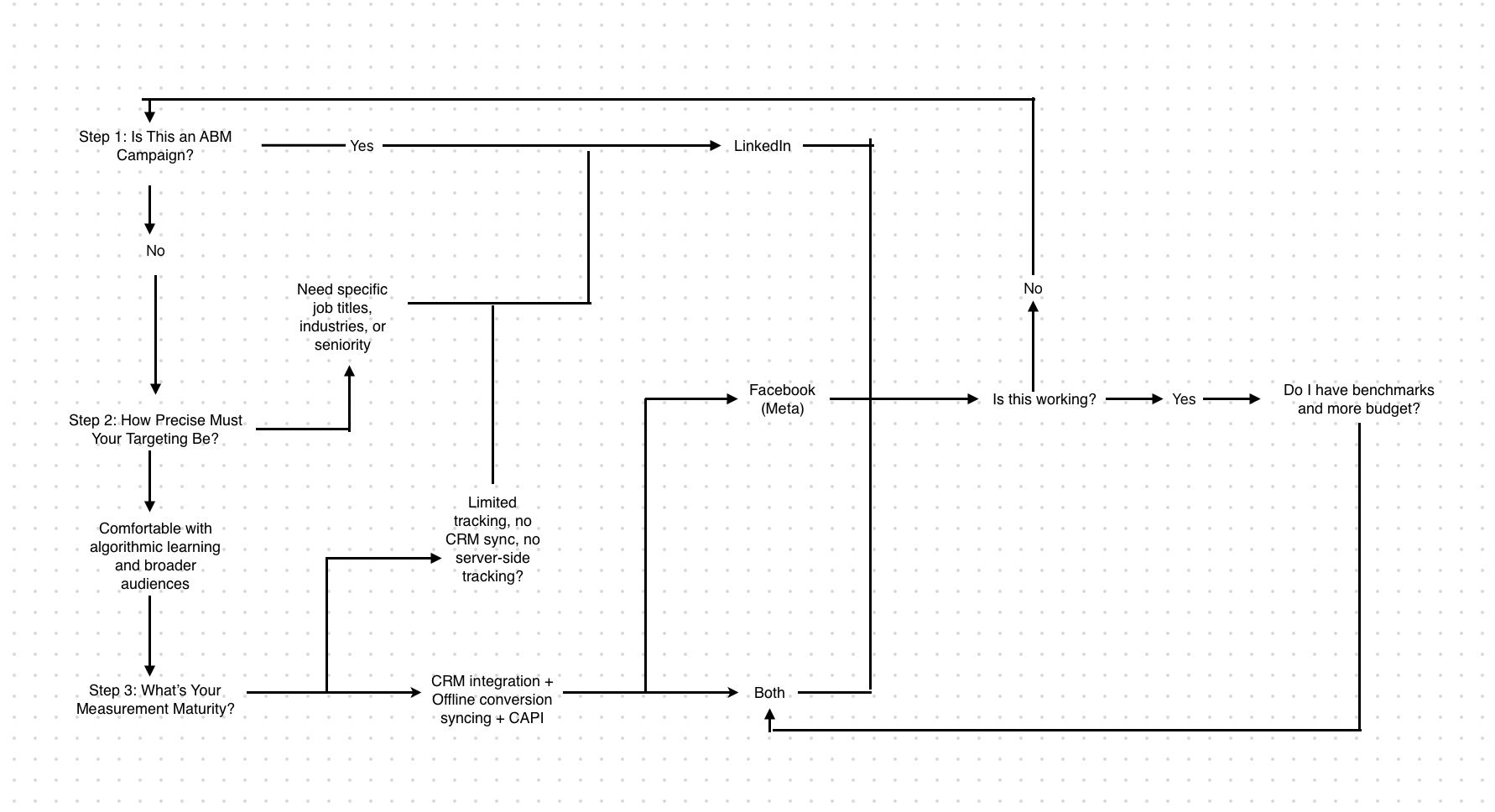
Making A Decision
Final Thoughts
The real question isn’t LinkedIn ads vs Facebook ads. It's how each platform fits into your demand generation system.
Meta can prove to be much more cost effective providing audience and measurement guardrails are set up in advance. Linkedin is lower-barrier to entry and less risk than Meta, providing you're able to defend your investment by establishing clear performance metrics and measurement up front.
Neither platform should be judged on CPC, CPL alone. Since It is now possible to measure pipeline influence and impact, both platforms should be compared by performance on these terms.